

Tango, the most honest mirror you’ll ever find
Ten years ago I started tango because I wanted to learn how to dance. Or at least, that’s what I thought. The real reason was deeper.
I had spent most of my life using my more masculine energy: building businesses, solving problems, organising, taking responsibility and staying in control. I wanted to explore a softer, more feminine side of myself. I wanted to discover what it felt like to move from being instead of constantly doing.
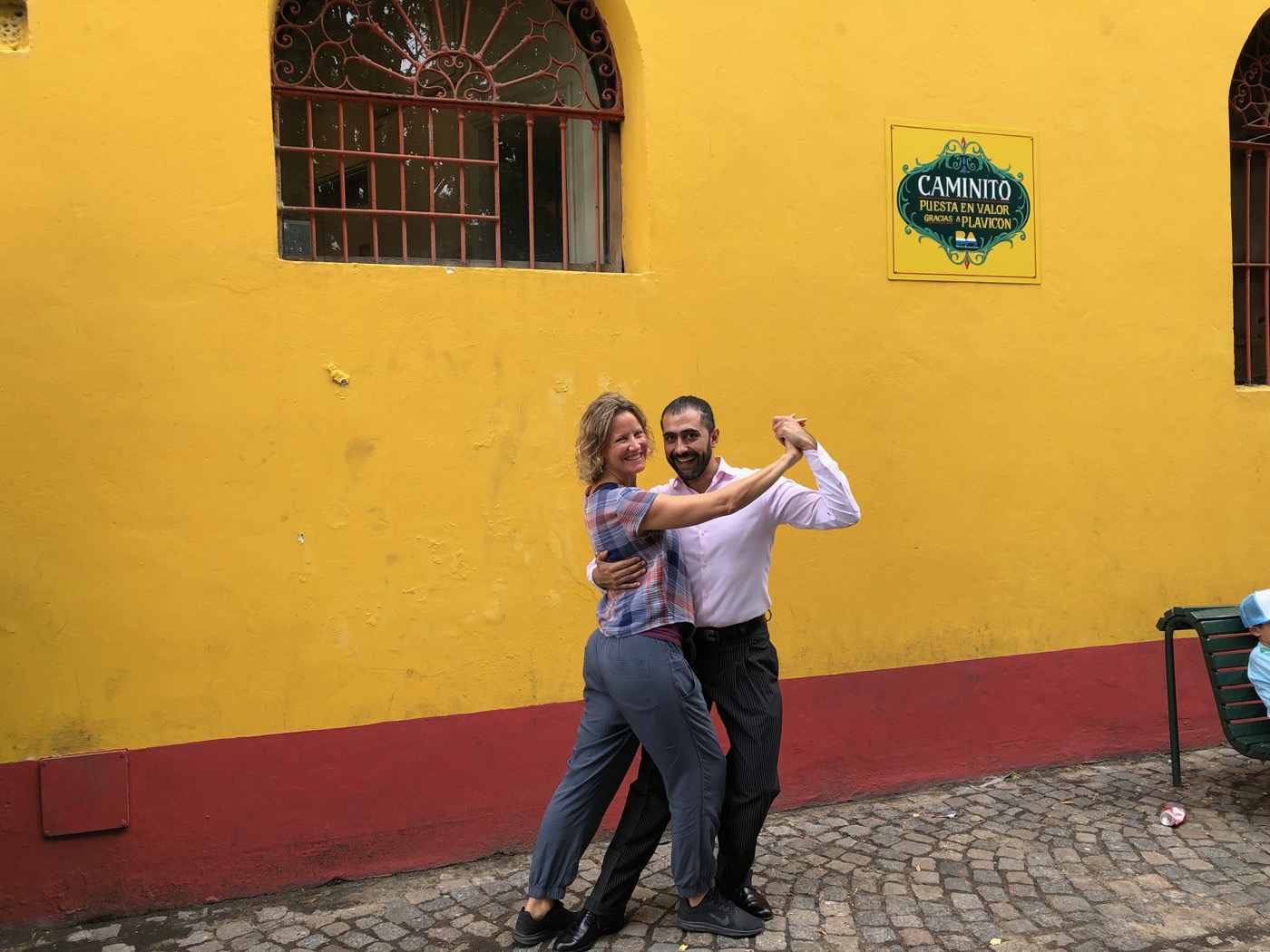
In Buenos Aires, I didn’t just learn steps. I learned to listen. To become aware of my body. To stay in the present moment. I discovered that following isn’t passive; it requires attention, trust and connection.
Tango became a mirror that gave me many insights.
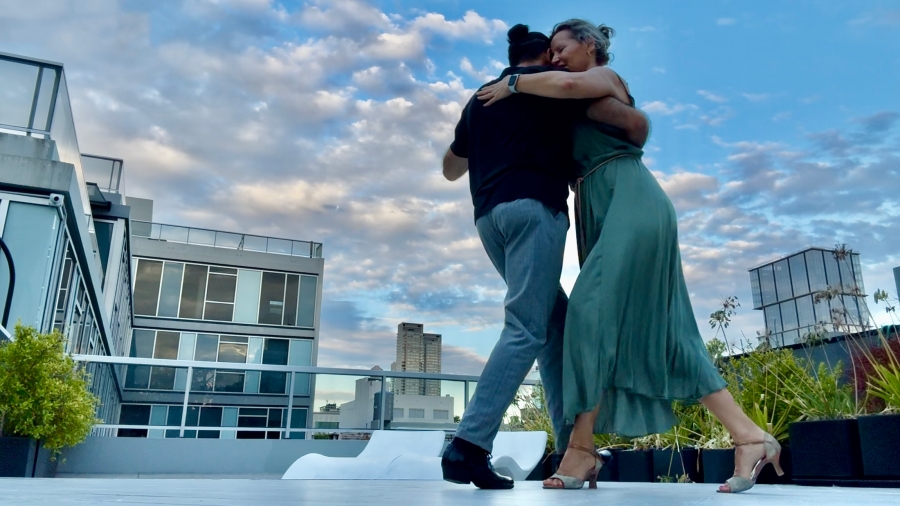
What fascinates me now is that tango never reveals everything at once. It keeps peeling back layers. The first mirror was physical and practical: balance, grounding, posture and presence. Later, the same dance began to reveal what lived underneath those physical habits: deeper patterns around control, trust, tension and disconnection between my head and my body.
And I see this disconnection everywhere around me. Men, and especially women, who live almost entirely in their heads. They have gradually lost contact with their bodies, their partners, their colleagues, the businesses they run, their own goals, the world around them and the ground beneath their feet. Most of all, they have lost contact with themselves.
Tango offers a surprisingly direct way to make that invisible disconnection visible. You feel it in the way you stand, breathe, listen, anticipate, take control or wait for someone else. That is why a dance can become such an honest mirror.
This blog follows those layers in the order in which I discovered them. First, the personal mirror: what tango showed me about my body, my confidence and the ways I had learned to keep myself standing. Then the wider mirror: how the same patterns shape the way we lead, follow, communicate, cooperate and respond to other people in life and business.
Experience Tango as a Mirror
Coming soon in Amsterdam, see tangoandcore.com.
Part 1: Tango as a Mirror for personal development
The first layer was physical
My first teacher in Buenos Aires, Adrián Luna, taught me much more than steps. During my first ten days, I made astonishing progress. From zero to dancing tango in such a short time felt almost unbelievable. Then the work became slower and less visible. Adrián turned my attention to balance, presence, grounding and the small details that hold a dance together. I discovered that everything I learned in tango revealed something about another area in my life and wrote about those first life lessons from tango.
I am used to creating 80 percent of the result in 20 percent of the time and often moving on when the easy progress is over. Tango asked me to stay.
That was confronting. I had to practise, tolerate slow progress and continue beyond the point where talent and speed usually carried me. I even considered turning the experience into a 21-day challenge, because making it a project appealed to my rational side. Eventually I chose to stop pushing and stay at my own level for a while. As soon as the pressure lifted, I enjoyed myself more and started improving again.
My body added its own clues. My balance was poor and my hips lacked stability. Tango confirmed what my physiotherapist, doctor and yoga teacher had already told me after my car accident: I needed to ground myself and strengthen my core. At that stage, I understood the mirror mainly as physical. I did not yet see what my body was holding underneath.
The joy that kept calling me back
For the first time in a long time, I was doing something I wasn’t naturally good at. Most of my life I had chosen things that came easily, or that I could master relatively quickly. Tango didn’t let me do that.
At the same time, tango gave me moments of pure joy, flow and connection unlike anything I had experienced before. For a few minutes, everything would click. My mind would go quiet. There was only the music, the embrace and the feeling of moving as one. I assumed those moments would become more frequent and the insecurity would gradually disappear.
When every dance became an evaluation
After a few years, something unexpected happened. Instead of becoming more confident, I became less confident. Every dance became an evaluation. Was that wrong? Did I miss the lead? Was I too slow, or too fast? Why couldn’t I simply trust my body?
I was constantly analysing, anticipating and trying to avoid mistakes. I was dancing almost entirely from my mind. Several times I came close to quitting. Yet the memory of those moments of flow kept calling me back. Somewhere underneath the frustration, I also knew tango was showing me something. I was trying to learn surrender while holding on to control with everything I had.
Back to the beginning
Ten years after those first lessons, I started again in Amsterdam. My teacher Damian Rosenthal took me all the way back to the beginning: standing, walking, breathing and feeling.
Damian sees straight through me. He notices exactly where my breath sits, where I hold energy, which muscles I unconsciously engage and even which toe I am leaning on. That allows him to give me remarkably precise feedback.
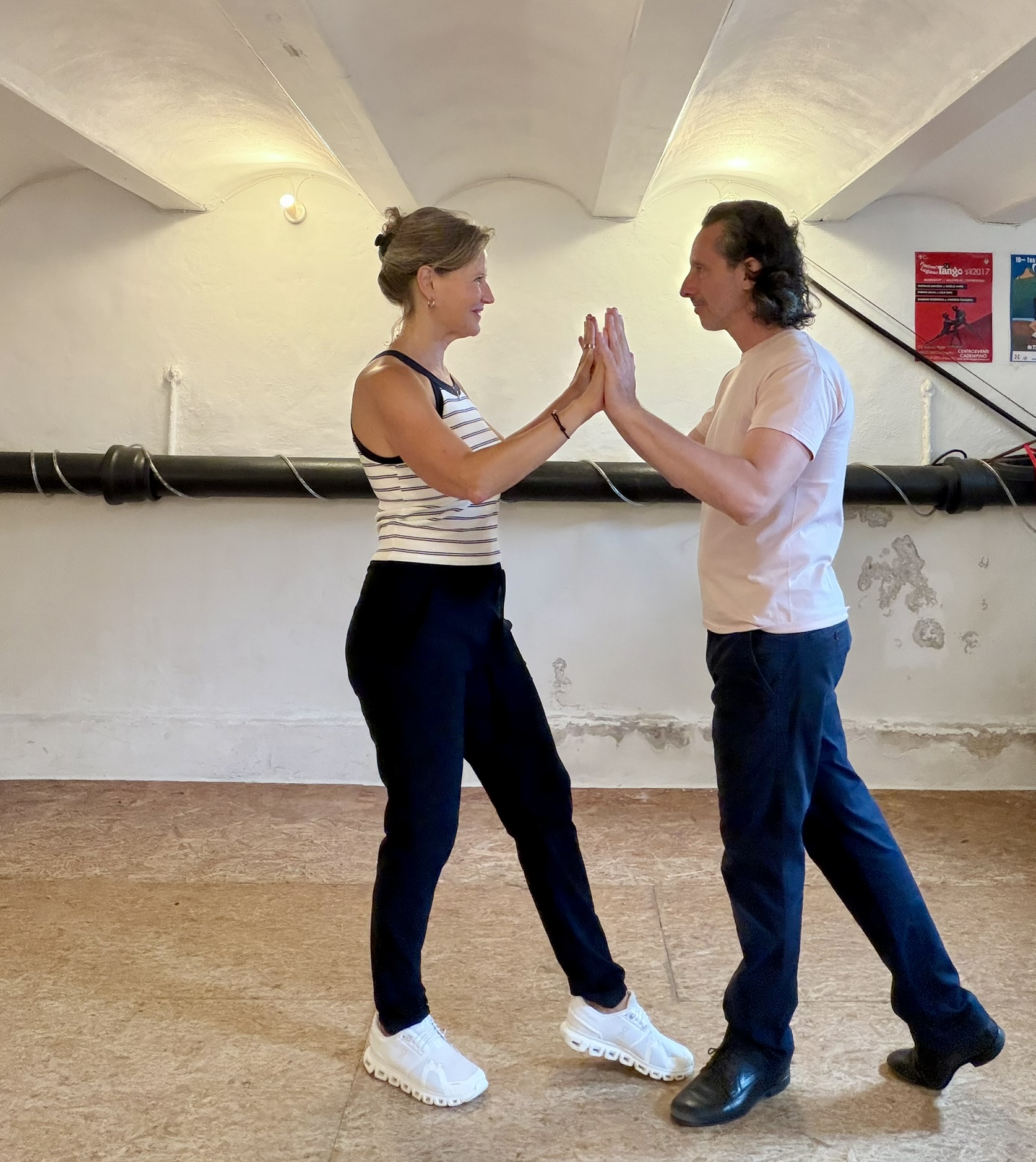
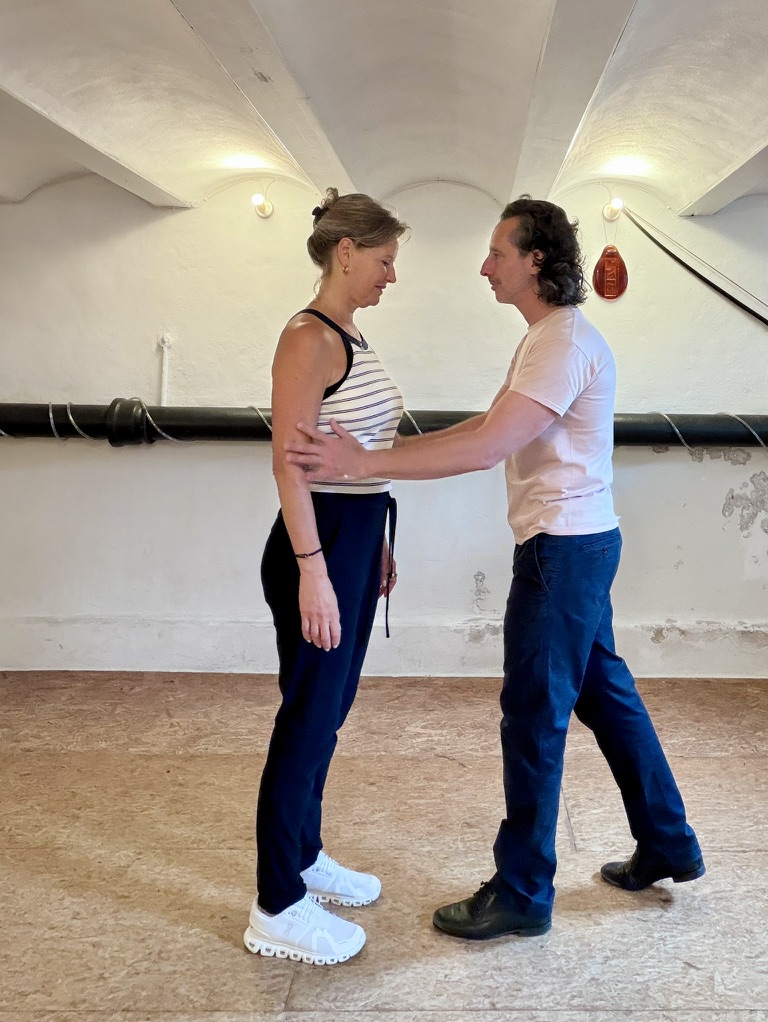
His feedback improves my dancing and exposes the tiny habits and patterns I have developed over a lifetime to keep myself upright, literally and figuratively. We take them apart, step by step, so I can rebuild from my own strength: relying less on my head and trusting my body more. My body often knows long before my mind catches up and reveals what words and analysis often cannot reach.
His instructions sound simple: “Relax. Connect. Don’t do it. Allow it.” The harder I try, the more tense I become. I recognise the same strategy in life: trying to surrender while remaining in control, and trying to trust while checking everything first.
People usually experience me as confident, decisive and capable. Tango shows what lives underneath that layer. I anticipate, analyse and take responsibility before I allow myself to feel what is actually happening. These patterns have helped me build a life and business, and they can also disconnect me from myself.
When the mirror went a layer deeper
Over the past year something has started to shift. The explanations haven’t changed much. I have. For the first time I can feel that my upper and lower body are connected. My body is beginning to understand things my mind has been trying to solve for years.
For a long time I honestly thought I was relaxed. Damian could feel that my feet were barely connected to the floor, my breath stayed high in my chest and my hips remained tense. I was holding myself together while calling it relaxation.
Real relaxation feels very different. When I release enough to feel my feet, my breath and the ground, I come back into contact with myself. My body can register what is happening, translate what it feels and respond. The movement becomes clearer because I am connected to myself, my partner and the shared direction of the dance.
My hips appeared in my first tango story as a physical weak spot, connected to balance, stability and core strength. Ten years later, the same part of my body is revealing another layer. The tension also tells me how much I hold myself together and how difficult I find it to truly let go. Hips are connected with femininity, sensuality, emotion, trust and surrender. The physical discovery has become a deeper exploration of how I move through life.
I don’t know when I’ll be able to fully release that control. Maybe next month. Maybe years from now. I do know that tango has been gently peeling away the layers of a personality that became strong because it had to. The dance doesn’t judge any of it. It simply reflects it back to me, one layer at a time.
Part 2: Tango as a Mirror for life and business
When the mirror expands
Once I recognised these patterns in my own body, I began to see them everywhere else. What starts as personal awareness becomes visible in every interaction. The mirror expands from one body to a couple, a relationship, a team or an entire organisation.
Years ago I facilitated several Tango as a Mirror workshops together with my tango teachers, to bring this approach into companies. A simple tango exercise quickly shows how people lead, follow, listen, communicate, trust and respond when they cannot plan every next step.
Participants are invited to notice what happens during the tango lesson and apply those observations to themselves, their lives and their work.
Doctors discover how they can coordinate and work together more effectively. Managers see how they lead, how clearly they communicate direction and how their leadership is received. Teams experience what changes when they listen, trust, adapt and stay connected while moving towards a shared goal.
The same thing happens in relationships and in business. If I am disconnected from myself, my surroundings or my intention, I fall back on speed, control and analysis. When I am grounded, I notice more: the hesitation in a colleague’s voice, the energy in a room, what a client is really asking and where a conversation wants to go. I can respond to what is actually happening instead of executing the plan in my head.
Connection gives intuition somewhere to land. It helps me stay aligned with myself, the people around me and the purpose we are moving towards.
What tango reveals in life and business
Tango is not about steps. The magic is in many small details.
Every embrace asks questions that reach far beyond the dance floor:
- Can you stay on your own axis without becoming rigid?
- Can you connect without losing yourself?
- Can you follow without disappearing?
- Can you trust when you don’t know what comes next?
- Can you receive, or do you always feel responsible for making things happen?
These are life questions. Through movement, patterns around trust, leadership, boundaries, communication and cooperation become surprisingly clear.
The goal is awareness. You don’t need dance experience. Your body often shows what your mind is still trying to understand.
We can keep changing strategies, circumstances, relationships and routines on the outside. When our internal compass is out of tune, those solutions only go so far. Once we recalibrate that compass and learn to feel again, we need much less from outside ourselves to know what is right and where to go. This may sound like a big promise. It is also what Tango as a Mirror can offer: a way back to your own signals, your own grounding and your own direction.
Experience Tango as a Mirror in Amsterdam
Tango as a Mirror gives you a direct experience of the patterns that shape how you work, relate and make decisions. Through movement, you may discover where you take control, lose connection, hold back, anticipate or struggle to trust, and what becomes possible when you respond with more awareness.
On Thursday 27 August 2026, I’m hosting an introductory Tango as a Mirror workshop in Amsterdam together with Damian Rosenthal and Vanessa Fatauros of Tango & Core. Through accessible Argentine tango exercises, you’ll explore how you lead and follow, how you listen and communicate, and how you adapt and cooperate when you cannot plan every next step.
No dance experience is needed. The workshop is beginner-friendly and suitable for anyone who is curious about what movement can reveal about the way we work, relate and make decisions.
Practical details
- Thursday 27 August 2026
- 7.30 to 9 PM
- Spuistraat 239 B, Amsterdam
- Donation-based
- Register: esther@estherjacobs.info