Love Does Not Stop
A Speech for My Father
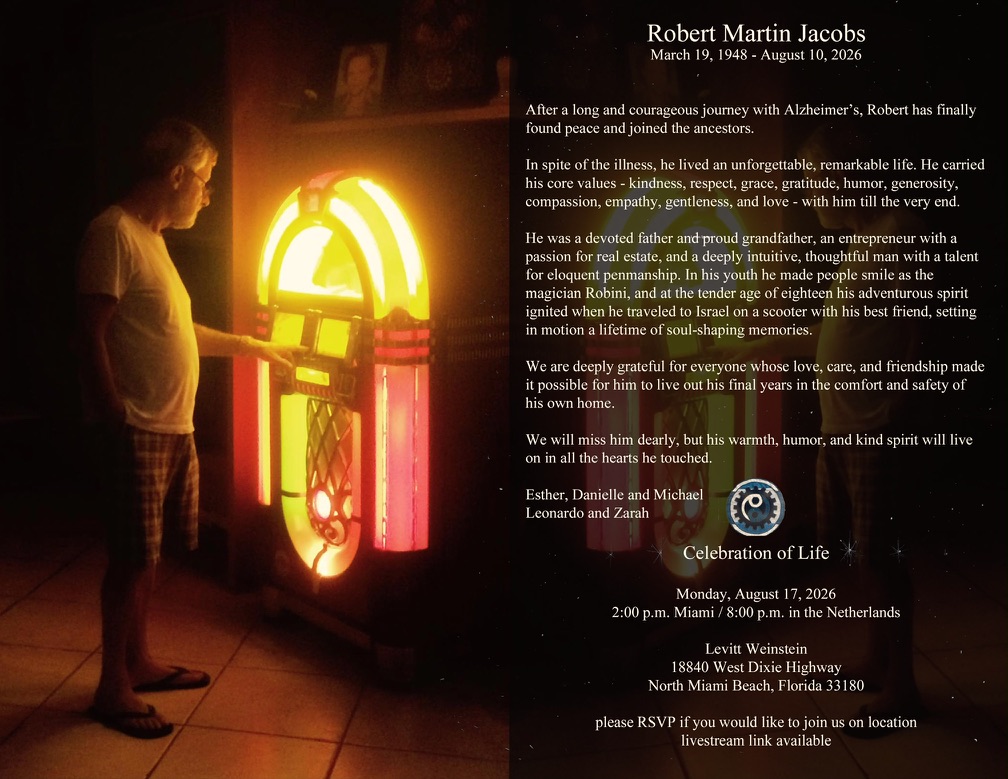
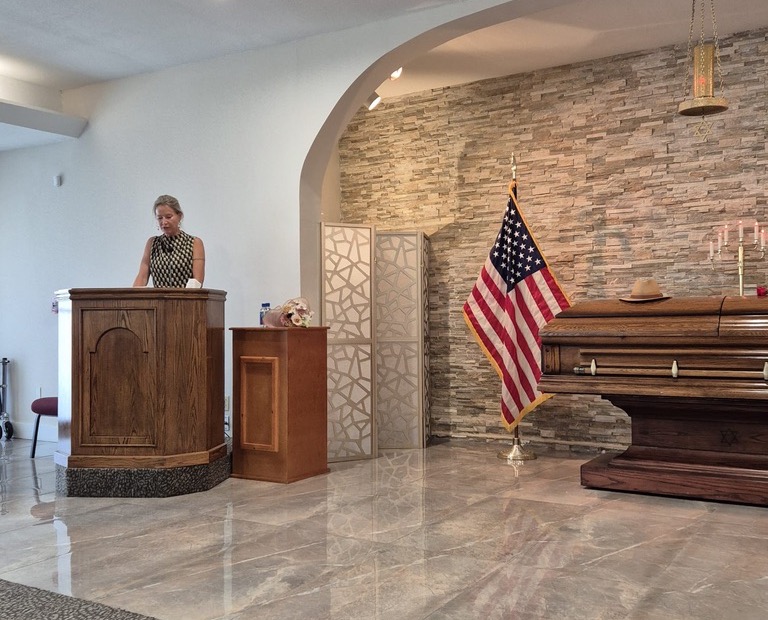
On August 17, 2026, I spoke at my father’s Celebration of Life in Miami. After ten years of living with Alzheimer’s and slowly saying goodbye, these were the words I wanted to share about love, loss, softness, surrender and everything he taught me.
3,650 days.
Ten years of checking my WhatsApp first thing in the morning.
3,650 times, and probably more, wondering whether my father was still alive.
For ten years, somewhere in the back of my mind, I was always taking into account the possibility that my father might die.
I wasn’t even fully aware of how deeply ingrained that had become until the past few days, when I realized that I don’t have to check anymore.
The thing I had been afraid of for all those years has now happened.
On a cloud
I am sure Dad is watching us from a cloud right now, with a big bowl of popcorn in his arms.
He loved eulogies. And often, after hearing a good one, he would tell us: “I hope I get a good one like that one day.”
Well, Dad, you’re getting what you wanted today.
And I can see you sitting there, proud of us, your kids, feeling the love from all of us here, and from all the friends and family watching the livestream.
What he taught me
My sister and my brother have already shared some stories about my father, and I could talk for hours about all the things my father did, and all the things we did together.
We made so many trips and did so many crazy projects together. And I learned so much from him.
He taught me to think creatively, to be entrepreneurial, to be flexible and work with what you have, to take risks, to stay optimistic, to never burn your bridges, to be kind, and to push through when pushing through was needed.
He taught me the power of language and eloquence, and the value of speaking different languages, of being able to communicate with people directly and take in information firsthand.
He taught me to keep learning. From other people, from biographies and books, but also simply by doing.
We traveled to weird countries like Moldova, and even to a non-existing one, Transnistria. We experimented with dowsing rods, pendulums, feeling energy lines, and whatever else caught our curiosity. There was always something new to discover.
He also taught me how to present myself to the world. How to be strong, how to succeed, how to stay strong for others, how to inspire people, and how to pass on what I had learned.
Imperfections
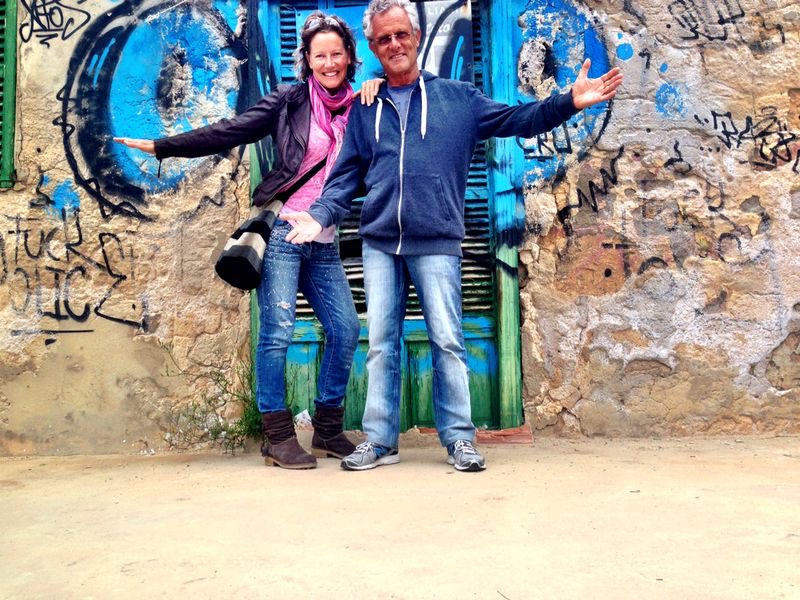
My mother said: “The way you write and talk about your father, he seems like a nice person…”
Of course, my father wasn’t perfect. And some of the things I learned from him came from seeing how his strengths sometimes got in his way.
He was incredibly strong and independent, which also meant that he found it very difficult to ask for help. Even when, in the early stages of Alzheimer’s, things started getting complicated in business and with his finances, he kept trying to solve everything himself.
And let’s just say, he made a bit of a mess of some things, which eventually his children had to help sort out. With a lot of love.
He also had a very strong sense of justice, just like I do. Which is a wonderful quality, until you become so determined to fight something you consider unfair that you become slightly unreasonable yourself.
I may have inherited that part too.
There were also a few things my father simply never mastered. Cooking, for example. Eventually he learned how to boil an egg. Sort of.
His solution was much simpler: go out for dinner or order food.
He lived large. Sometimes larger than was entirely realistic. But scarcity thinking simply wasn’t in his system. He believed there would always be a solution.
And then there were relationships.
Let’s just say that choosing life partners was perhaps not his greatest talent. I’m not entirely sure he ever solved that particular mystery.
But I love the fact that the universe seems to have had the last word on that one. During the final years of his life, he was surrounded by at least one, often two, and sometimes even three beautiful, loving women who cared for him with their whole hearts.
So in the end, he did get to experience what it felt like to be completely surrounded by love.
The lesson of surrender
Just like me, my father believed there would always be a solution.
But eventually, he found himself in a situation for which there was no solution. Nothing he could fix, fight, negotiate, or think his way out of.
And perhaps the greatest lesson he taught me during those final ten years was much more about being than doing.
I watched the way he surrendered to the situation.
In a way, my father had done that his whole life.
Work with what you have. Be flexible. Deal with whatever happens. Make the best of it.
But in those last years, I saw another side of that lesson.
Sometimes there is nothing left to fix. Sometimes you simply have to accept the situation for what it is.
And he did.
Love and loss
The love I felt for my father was so big that, for a long time, I was almost afraid to fully let it in. Because if you allow yourself to feel that much love, you also know how much it will hurt when you lose that person.
And I think he was a little bit the same.
We knew we loved each other, but we didn’t really say it. We kept a certain distance. We weren’t big huggers.
And we also argued quite a lot, because intellectually, we were a good match. We could challenge each other. A lot.
But from the moment I knew my father had Alzheimer’s, there was this big knowing that one day I was going to lose him.
And somehow, those ten years became a kind of race against time.
I’m incredibly grateful that I was able to spread the grief of losing him over ten years. Because I think if I had had to feel all of this at once, it would simply have been too big to carry.
And even after grieving all those little pieces over all those years, this still hurts terribly.
Softer
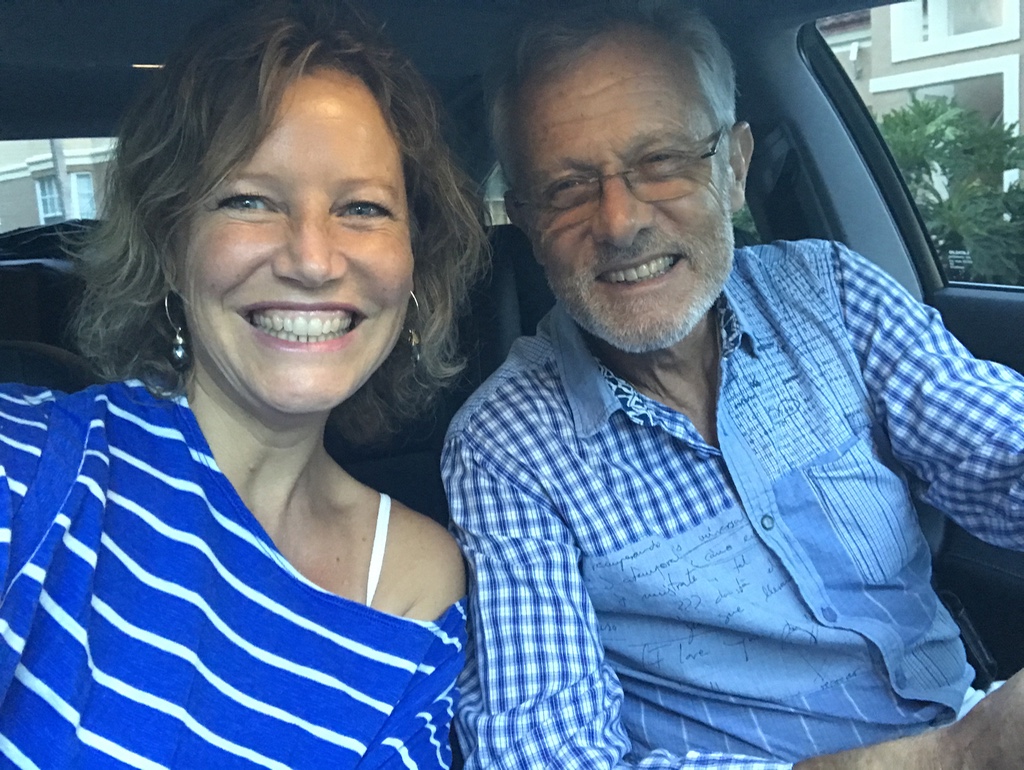
Alzheimer’s took so much away from my father. But strangely enough, it also gave us something.
It gave us ten years to learn how to love each other differently.
During those ten years, I watched our roles reverse, from him taking care of us, to us taking care of him.
I did what I always did best: organize! I fulfilled his bucket-list wish to travel to Indonesia, where his father Martin was born. I organized a system of lovely caregivers to live with Dad and support Danielle.
At first, I kept my distance, trying to avoid the pain. Then I slowly allowed myself to come closer.
And eventually, I allowed myself to really feel the love that was there.
Some people’s personalities change when they are drunk, when they use drugs, or when they develop dementia. Some become distant, aggressive or demanding.
My father just became softer.
Kinder.
Sweeter.
And perhaps because he softened, I could soften too.
In the second half of our journey together, I learned that I could take off the strong mask he had taught me to wear.
That there is strength in softness too.
That I could show vulnerability.
That I could open my heart and let the love that had always been there actually flow.
Home
And perhaps that softness was also part of what made my father feel like home.
Especially in my life, without a fixed home or even a country that I really belong to, places have always come and gone. Homes disappeared, circumstances changed, and I kept moving.
But somehow, my father was always home.
I think that was true not only for me, but also for Michael and Danielle. Wherever he went, he had this ability to create a sense of home around him. A place where you wanted to come back to. Where you felt welcome.
And it wasn’t just us. Friends like Astrid felt it too.
Amstelveen with Doris became such a place. Curaçao became such a place. And Aventura became such a place.
For someone like me, who has chosen a life without many physical anchors, my father was always an anchor in the world.
He kept connecting
Robert was a spiritual person.
And even when Alzheimer’s had already taken so much of him away, he somehow kept connecting with people he loved.
At the beginning of this year, I wanted to go to a Mystery School in New Zealand. It was about as far away from my father as I could possibly be.
Before I went, I asked him energetically: “Dad, if I go there, I won’t be able to get back immediately if something happens to you.”
And in my head, I heard him answer: “Just go. I can communicate with you better when you are there than when you are here.”
So I went.
And while I was there, during an important moment of ‘sacred union’, a kind of wedding ceremony, I was walking down the aisle when I suddenly felt my father walking beside me energetically.
He was there when I needed him.
I regularly dreamed about him too.
Two days before he died, I dreamed that I had to have his passport checked. I even went back a second time to make absolutely sure that everything was in order.
So that he was ready to travel.
And apparently, I wasn’t the only person he visited.
In those final days, several people sent messages saying that they had dreamed about him, had suddenly thought about him, or had felt his presence.
It seems that in his own way, my father went around saying goodbye.
Signature
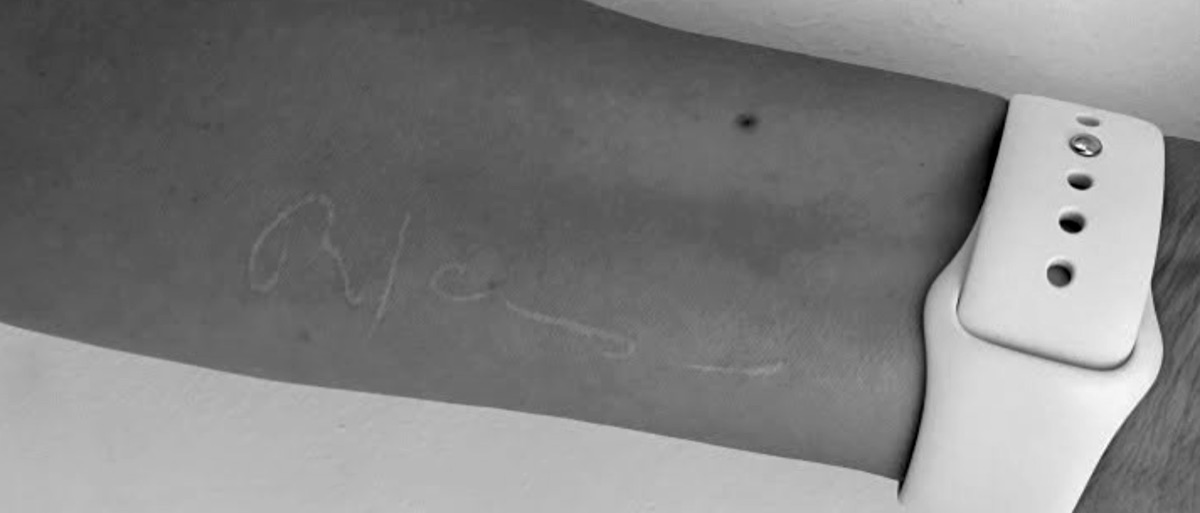
At the beginning of his Alzheimer’s, I had my dad’s signature tattooed on my forearm.
I knew that slowly his personality, all those recognizable pieces of him, would start disappearing.
And I wanted to have some of his energy with me forever.
So now I literally carry him with me.
I realized that when I get stuck, when I close down, when my heart closes, connecting with my father is one of the ways I can find my way back into my heart.
And I am so incredibly grateful to him for that.
Love does not stop
His body is gone. His voice is gone. But the love isn’t gone.
Love doesn’t stop when somebody dies.
Love continues.
And maybe, in the end, we ARE love.
Thanks
So thank you, Dad. Dankjewel, lieve Vaders.
For all the adventures. For the crazy projects. For everything you taught me. For challenging me. For making me laugh. For becoming softer. For allowing me to become softer too.
For always giving me a place that felt like home.
But most of all, thank you for who you are.
I love you.
Till we meet again. And I am sure we will.